This article has been co-authored by Ann Harten and Craig Pattison FCIPD bringing together US and UK perspectives on AI, governance, organizational design and leadership capability.
Owners, boards, and executive teams are being asked to rapidly approve AI strategies, productivity initiatives, and workforce redesigns. The business case is often persuasive: faster workflows, lower costs, better data, higher productivity, and fewer people needed for routine tasks. But one question is still not being asked clearly enough.
If AI changes the shape of the organization, how will the business continue to build the judgement it needs to protect its future?
For family-owned and privately held businesses, that question matters. Legacy is not only about ownership, succession or reputation. It is also about how commercial judgement, operational knowledge and institutional memory are passed from one generation of leaders to the next. AI is not simply changing tasks. It is changing the structure through which people learn, progress, manage complexity and develop the judgement required to lead.
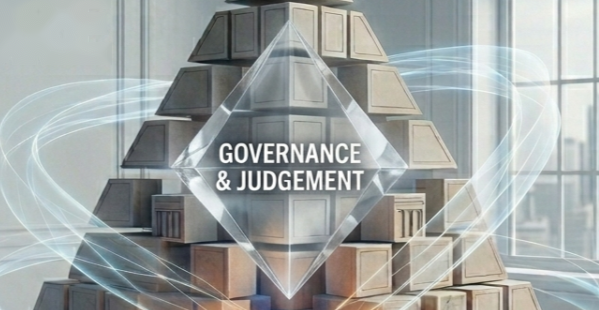
For decades, the organizational pyramid did more than allocate work: it developed capability. People entered near the base, learned how work was done, built pattern recognition through experience, and moved upward as their judgement matured. Managers translated strategy into action, escalated issues, corrected errors and developed the people beneath them. The pyramid was inefficient in many ways, but it had one advantage that is now easy to overlook: it built institutional understanding through experience.
This is not an argument against AI, automation or progress. Used well, AI can remove low-value work, improve decision support and help privately held businesses become more resilient, responsive and competitive. The point is not to preserve outdated structures for their own sake. It is to ensure that, as work is redesigned, owners and boards make conscious decisions about the capabilities, judgement and institutional knowledge the business still needs. AI puts that model under pressure.
The pyramid is being weakened from more than one direction
Three assumptions that supported the traditional pyramid are now breaking down.
The first is that information needs human intermediaries. In a traditional organization, middle managers acted as translators. They converted strategy into operational instruction and operational information into decision-ready insight. AI-enabled systems are now performing parts of that role. They can summarize data, surface anomalies and produce executive-ready outputs, provided they are connected to the right systems and governed appropriately. The information brokerage that once justified layers of management is being compressed.
The second assumption is that routine work requires human presence at scale. The base of the pyramid has historically been built around high-volume, rules-based activity: processing claims, reconciling accounts, managing inventory, handling standard customer enquiries, preparing reports and coordinating administration. Robotic process automation started reducing this work more than a decade ago. Generative AI and intelligent agents are now accelerating the shift. The base of the pyramid is not disappearing overnight, but it is narrowing. In some organizations, the roles where people once learned the basics of commercial judgement, operational discipline and organizational reality are being reduced before alternative development routes have been designed.
The third assumption is that coordination is inherently manual. Cross-functional work, scheduling, project management, resource allocation and workflow tracking have traditionally required human effort to keep activity moving. Increasingly, AI-enabled tools can manage elements of this coordination. But this does not remove the need for coordination. It changes the nature of it. The work moves from chasing activity to interpreting output, challenging assumptions and understanding what the connections mean. That is where the real risk sits. Organizations may not need the same number of people performing routine work at the base. They may not need the same layers of information brokerage in the middle. But they may need a stronger middle layer able to interpret, challenge and govern AI-enabled work. That is not a technology issue. It is an operating model issue.
The hidden risk: organizations may remove the work that builds judgement
Most AI adoption is still being considered through the lens of efficiency, productivity and competitive advantage. Those are legitimate priorities, but they are incomplete. The deeper question is not simply where AI can be deployed. It is what human capability is being removed, weakened or left unreplaced as work is redesigned. The distinction matters because workforce structure and capability development have always been connected. The traditional pyramid was not just an operating model. It was also a development model. People build judgement by doing real work, seeing real consequences, handling exceptions, learning from mistakes and being exposed to progressively more complex decisions.
When entry-level work is reduced, middle layers are compressed, and routine tasks are automated, the development pipeline changes with it. For family-owned and privately held businesses, this has particular significance. Succession is not only about who owns or leads the business next. It is about how commercial judgement, operational knowledge and institutional memory are transferred over time.
If routine work is automated, junior roles are reduced, and experienced managers become the only people who still understand how the business really works, AI-led efficiency can unintentionally increase key-person dependency and weaken the leadership pipeline owners are trying to protect. What happens when fewer people gain the experience needed to step into those management roles? That should matter to any owner or board thinking about long-term continuity.
Emerging labor-market research reinforces why this issue deserves attention. U.S. studies by Brynjolfsson, Chandar and Chen, and by Hosseini Maasoum and Lichtinger, suggest that early-career and junior workers may be disproportionately exposed to the employment effects of generative AI. The UK evidence base is still less developed, but the same structural question applies here too. If routine entry-level work is reduced, automated or redesigned before organizations have created alternative routes for developing judgement, the issue is not only labor-market disruption. It is a future capability risk for employers.
The immediate risk is not just that AI reshapes workforce structures, but that businesses approve new operating models without fully considering how judgement, task understanding, and management capability will be maintained.
The middle layer may become more important, not less
A common assumption is that AI will simply reduce management layers. In some cases, it will. But the more important point is that AI changes what management is for.
As AI-supported tools and agents take on more routine execution, some decisions will move downward to frontline employees and automated systems operating within clearer parameters. Other decisions will move upward, especially where the implications involve risk, ethics, regulation, investment, reputation or cross-enterprise trade-offs. The middle layer sits between those movements. Its role becomes less about supervising activity and more about interpreting outputs, coordinating across people and systems, challenging assumptions, and deciding when human intervention is needed. That requires a different level of management capability.
Managers will need enough understanding of the underlying work to know when an AI-generated output is credible, when the data is weak, when the assumption is wrong, and when a decision should be escalated rather than accepted. That is not narrow technical expertise. It is operational judgement. This matters because many organizations have already pushed more responsibility onto middle managers over recent decades without investing enough in their development. Senior layers have been reduced, spans of control have increased, and managers have been expected to absorb more complexity while still delivering day-to-day performance. AI does not remove that problem. It intensifies it.
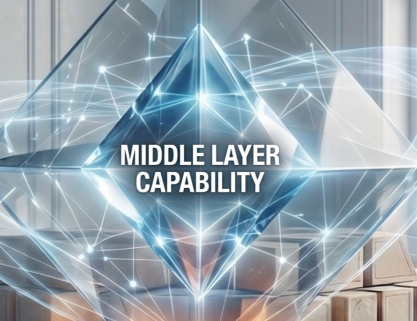
A diamond-shaped organization only works if the middle is strong enough to carry the judgement, coordination and oversight that the new structure demands. If it is not, businesses risk building leaner structures that are faster, cheaper and more automated — but weaker at understanding their own work. For privately held businesses, that weakness can be especially dangerous. A small number of experienced operators may still know how the business really works, but if their judgement is not being transferred, the business becomes more fragile than its productivity numbers suggest.
This is a stewardship issue, not just a technology issue
This issue sits between strategy, workforce planning, technology investment, succession and organizational design. That is precisely why it can fall between functional remits without being clearly owned. Owners and boards that treat AI mainly as a technology agenda item are likely to miss the capability risk. Those that treat it only as a productivity lever are likely to miss the operating model risk. Those who approve workforce redesign without asking how judgement will be developed in the new structure may be trading long-term continuity for short-term efficiency.
For family-owned and privately held businesses, this is also a question of stewardship. AI may help capture information, but it does not automatically preserve institutional memory. In many privately held businesses, the most valuable knowledge is not written down. It sits in experienced people who know which customer issue matters, which supplier risk is real, which margin movement is unusual, which operational workaround is hiding a deeper problem, and which number does not feel right.
In these businesses, judgement is often shaped by more than process. It reflects values, reputation, customer relationships, supplier history and long-term owner intent. Those factors need to be designed into AI-enabled operating models, not assumed.
The difficulty is that this risk is rarely visible in a standard AI business case. It is not found in headcount plans, productivity forecasts or technology roadmaps. It appears later: in weaker judgement, thinner succession pipelines, over-reliance on a small number of experienced operators, slower escalation of poor decisions, and managers who are accountable for AI-enabled work they do not fully understand. That is why this should be on the agenda before the new operating model is set, not after the consequences arise.
The practical challenge for owners and boards is that most businesses do not yet have a clear way to test this. They may know where AI is being deployed, what savings are expected and which processes are being redesigned. But they may not know whether the business is protecting the judgement, institutional memory and management capability it will need in three, five or ten years’ time.
The diagnostic questions owners and boards should now be asking
Owners, boards and executive teams need a more practical diagnostic before approving AI-led workforce redesign or assuming existing governance processes are enough.
First: where will judgement be developed?
In a privately held manufacturing, distribution or specialist services business, junior commercial, operations and finance employees have historically learned by working through real customer issues, supplier problems, margin anomalies, stock constraints, service failures and exceptions that do not fit the process. If AI now drafts the summary, identifies the variance, prepares the recommendation and routes the decision, where do future managers learn the judgement needed to know when the system is wrong?
Second: what happens to the capability pipeline?
AI business cases often quantify cost savings and productivity gains. They rarely quantify what is lost when the roles being redesigned are also the roles through which people historically learned the business. That gap should not be treated as an HR detail. It should be part of the investment case within the department or business unit.
Third: does AI reduce key-person dependency or increase it?
Many privately held businesses already depend heavily on a small number of trusted, experienced people. If AI removes novice learning routes while leaving judgement concentrated in the same small group of senior operators, the business may become faster but more dependent on fewer people. That is not resilience. It is hidden vulnerability.
Fourth: what is the future role of the middle layer?
If managers are expected to coordinate work across people, systems and AI-enabled tools, what new capabilities will they need? Are they being developed for that role, or simply expected to absorb it?
Fifth: who owns capability in the new operating model?
In the traditional pyramid, capability development was partly embedded in the hierarchy. In flatter, AI-augmented organizations, it must be designed deliberately. If leadership cannot identify who is accountable for sustaining judgement and management capability as the operating model changes, that is itself a governance finding.
The real issue is not AI adoption. It is whether continuity is being designed in.
The businesses that navigate this transition well will not be those that simply deploy AI fastest. They will be those that understand what AI is really changing.
It is changing how work is organized. It is changing how decisions are distributed. It is changing how people learn. It is changing what managers are for. It is changing how future leaders are built. It is changing how institutional memory is preserved.
That makes AI a question of governance and stewardship, not just a technology one. The businesses that move fastest will not necessarily be those that automate most aggressively, but those that can see clearly which capabilities must be protected, redesigned or deliberately built as AI changes the shape of work.
The pyramid is under pressure. The old model may not survive in its familiar form, and in many businesses it probably should not. But whatever replaces it must still answer the question the pyramid answered imperfectly but powerfully for decades:
How does this business build the judgement it will need to lead, govern and execute in the future?
For family-owned and privately held businesses, that question goes to the heart of continuity, succession and legacy. Boards and owners that can answer it will be better placed to govern AI-led change deliberately, rather than simply approve it.
Ann M. Harten is the founder of C-Suite Advisor, an AI strategy advisory practice working with corporate enterprises on governance, operating model design and leadership capability in the age of AI. She brings 25 years of executive experience spanning CIO, CHRO and VP of Global AI Transformation roles, and completed MIT’s Executive Education program in Deploying AI for Strategic Impact. Ann is an NACD certified board director and serves on three corporate boards.
Craig Pattison FCIPD is an executive coach, fractional Chief People Officer and strategic advisor working with CEOs and senior leaders at the intersection of people, technology and organizational change. A former Chief People Officer and Chief Technology Officer, he has led enterprise people, technology and transformation agendas in PLC, private-equity-backed and regulated environments. He is the creator of the Root-to-Result® coaching model and writes on leadership, capability, operating models and execution.